Funny Old Surfer Embroidery Design
First Impression: Quirky, Nostalgic, and Instantly Memorable
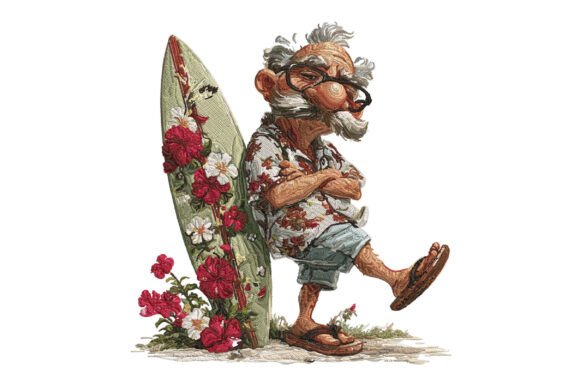
As an embroidery designer who’s prepped over 200 craft fair booths in the past decade, my first reaction to Funny Old Surfer Embroidery Design is genuine delight—it lands exactly where it should: warm, witty, and unmistakably summery. The mental image—a silver-haired man with round glasses lounging beside a floral surfboard—immediately reads as vintage beach charm meets gentle humor. It’s not loud or edgy; it’s clever, approachable, and deeply human. That’s gold at a craft fair, where shoppers scan dozens of tables in under ten seconds. This design doesn’t shout—it leans in with a wink and a sun-bleached smile.
Where It Shines: Craft Fair & Handmade Market Product Pairings
Tote bags are the top performer for Funny Old Surfer Embroidery Design. Centered on a natural canvas or oatmeal linen tote, the composition balances beautifully—enough visual weight to anchor the bag without overwhelming it. The floral surfboard adds texture; the figure adds narrative. Customers pause, smile, and imagine gifting it to their retired uncle or beach-loving aunt.
Aprons work exceptionally well too—especially relaxed-fit, pocketed styles in denim or heavyweight cotton. Placed just above the left pocket or centered on the bib, the design feels intentional and artisanal, not generic. It elevates a functional item into a conversation starter.
Tea towels benefit from the design’s clean silhouette and moderate scale. On tightly woven flour-sack cotton, the glasses and surfboard details hold up beautifully—even when stitched at 4.5" wide. Avoid overly textured or looped terry cloth, though: fine lines may blur.
Embroidered patches are a smart secondary use. As a 3"–3.5" iron-on or sew-on patch, Funny Old Surfer Embroidery Design becomes highly portable—ideal for jackets, backpacks, or market-branded staff gear. Just confirm the file includes clean satin-stitch borders and minimal underlay for crisp edges.
For caps, proceed with caution. The curved surface and small crown area compress vertical space—test stitch density and spacing on scrap twill first. A simplified version (e.g., surfboard only, or figure + board without floral fill) often converts better here.
Pillow covers and small fabric pouches make strong giftable items—especially in coordinating summer palettes (seafoam, coral, sandy beige). The design’s inherent warmth pairs naturally with handmade quality cues: French seams, contrast binding, linen-cotton blends.
What Makes It Sell: Attention, Clarity, and Emotional Hook
This isn’t just another beach motif—it’s emotionally resonant. At a craft fair, Funny Old Surfer Embroidery Design stands out because it avoids cliché. No palm trees. No “Aloha” script. Just quiet, character-driven storytelling that invites connection. Buyers don’t just see embroidery—they see a vibe, a memory, a personality.
It photographs exceptionally well for Etsy listings and social previews: high contrast between figure and background, clear negative space around key elements, and built-in color story (glasses frames, floral accents) that pops against neutral fabrics. That means less editing time and stronger thumbnail recognition.
For batch production, the design is highly repeatable—no tiny lettering, no micro-dense fills, no overlapping thread layers that risk puckering. As a machine embroidery design, it’s likely optimized for smooth hooping and consistent tension across common hoop sizes (4x4" to 5x7"). Still—always verify before cutting fabric.
Careful-Use Notes: Protect Your Stitch Quality
- Avoid dense floral fills on textured towels—they can flatten detail. Opt for open satin or stem-stitch outlines instead.
- On dark fabric, double-check thread contrast—especially for the glasses’ lenses and surfboard highlights. Light ecru or soft yellow threads often lift better than stark white.
- Don’t shrink Funny Old Surfer Embroidery Design below 3" wide. The glasses’ arms and floral stems lose legibility quickly.
- For thick fabric like denim aprons or canvas market bags, use medium-weight cutaway stabilizer—not tear-away—to prevent distortion around the figure’s seated pose.
- The surfboard’s curvature demands precise digitizing. If your embroidery file shows stitching gaps or inconsistent fill angles, request a revised version before bulk production.
Designer-to-Designer: Essential Pre-Production Checks
Before you commit yardage or list your first handmade product, run these checks:
- Stitch a sample on your exact fabric texture—not just muslin. Linen, canvas, and tea towel weaves behave differently.
- Compare thread colors side-by-side on fabric. What looks vibrant on screen may mute on oatmeal linen.
- Confirm hoop size compatibility with your machine—and whether the design fits within your standard frame without re-hooping.
- Inspect stitch density in the floral surfboard area. Overly tight fills cause stiffness and thread breakage on long runs.
- Create at least one real-world printable mockup—not just digital. How does it drape? Does the figure tilt visually on a curved tote?
- Review commercial licensing terms. If selling finished goods, ensure your digital embroidery file permits commercial embroidery use.
Final Thought: A Summer Staple With Staying Power
Funny Old Surfer Embroidery Design isn’t just seasonal—it’s timeless in tone. It bridges generations, speaks to slow-living values, and carries zero trend fatigue. For Etsy sellers, boutique makers, and small shop product lines, it’s a rare find: humorous without being juvenile, nostalgic without feeling dated, and detailed enough to signal craftsmanship—but simple enough to produce reliably. In your booth, it won’t just sit on a shelf. It’ll make someone laugh, point, and say, “That’s *so* my dad.” And that? That’s how craft fair sales begin.