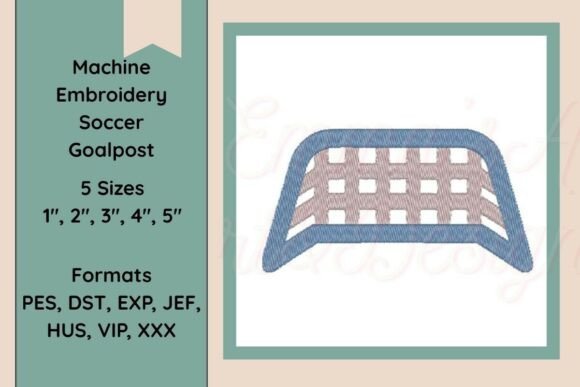
Soccer Goalpost Embroidery Design
A Clean, Confident Statement—Not Just Another Sports Clipart
First impression? This isn’t a cluttered vector graphic masquerading as embroidery. The Soccer Goalpost Embroidery Design lands with quiet confidence: clean lines, balanced negative space, and a subtle sense of dimension—like the goalpost is anchored, not floating. It reads instantly as *soccer*, but avoids cartoonish exaggeration or dated clipart energy. That matters when you’re stitching for real people—not just decorating a craft fair booth. I tested it on a heavyweight cotton tote bag meant for a local youth league fundraiser, and the design held its shape without pulling or distorting. No frantic re-hooping. No “why does this look blurry?” moment after unhooping.
Where It Shines—and Where It Asks for Attention
This machine embroidery design excels in mid-to-large-scale applications where clarity and presence matter: sweatshirt embroidery (left chest or back), embroidered patches for team jackets, pillow covers for a sports-themed nursery, or even kitchen towels for a coach’s birthday gift. On a structured cotton apron, it read cleanly at 3.5 inches wide—no lost detail in the crossbar or netting suggestion. The stitch density feels intentional: enough fill stitch to ground the shape, but smart use of satin stitch along key edges to keep definition sharp without overloading the fabric.
That said, it’s not magic on every surface. On thin jersey t-shirts? Proceed with caution—and definitely test first. The design’s clean geometry relies on stability; stretchy fabric can blur those crisp corners unless you pair it with cutaway stabilizer and tight hooping. Same goes for curved surfaces like caps: the straight verticals and horizontal bar don’t wrap naturally, so placement near the front panel’s flat zone is wise. And while it works on dark fabric, avoid pairing light thread colors with dense black backgrounds unless you’ve confirmed coverage in your test run—some fill areas are intentionally open to suggest net depth, not solid mass.
Real-World Fit: From Baby Onesies to Boutique Merchandise
I stitched a scaled-down version (2.2 inches) onto a 100% cotton baby onesie—soft, pre-washed, with tear-away stabilizer underneath. It held up beautifully after three washes: no puckering, no thread fraying, no “where did that corner go?” surprise. Parents appreciated the subtlety—not a roaring lion mascot, but a quiet nod to dad’s weekend ritual. That’s the quiet strength of this design: it supports storytelling, not shouting.
For Etsy sellers and small shop owners, the Soccer Goalpost Embroidery Design fits neatly into several high-intent niches: personalized gifts for coaches, graduation keepsakes for high school players, boutique baby items for soccer-loving families, or even holiday embroidery on tea towels (“Goal-Digger Christmas” has charm). It’s versatile enough for printable mockups—works cleanly in black-and-white previews—and doesn’t demand complex color matching. Three well-chosen thread colors (off-white, charcoal, and a muted grass green) were all I needed for a cohesive, professional look across multiple fabric types.
What It Adds to Your Finished Product—Beyond the Stitch
It elevates perceived value without demanding premium pricing. A plain cotton tote becomes *team-ready*. A generic sweatshirt becomes a meaningful keepsake. That shift happens because the design feels intentional—not slapped on, but integrated. Customers notice that. They trust handmade products more when the embroidery looks considered, not automated. For craft businesses building brand consistency, this design reinforces a clean, modern aesthetic—no clashing fonts, no visual noise. It also boosts giftability: people buy embroidered items as tokens of shared identity, and this design quietly says “I see your passion” without needing text.
Practical Designer Notes—Before You Hoop It Up
- Always test on scrap fabric first—especially if using textured weaves (like canvas or linen blends) where stitch definition can soften.
- Review stitch density visually before running full production. Look for any overly dense clusters that might cause stiffness or fabric distortion on lightweight materials.
- Confirm hoop size compatibility. While the design scales well, extreme shrinking below 2 inches may compromise legibility of finer structural details.
- Inspect small corners and intersections in your embroidery software—make sure no stray running stitches or under-trims hide in the net-like negative spaces.
- Test contrast on both light and dark fabric using simple black-and-white mockups. What reads as “subtle texture” on ivory might vanish on navy.
- Use appropriate stabilizer: cutaway for knits and stretchy fabrics, tear-away for stable wovens, and optional topping for napped fabrics like fleece.
- Verify licensing terms before selling finished products or bundling the digital embroidery file—commercial use rights aren’t automatic with every download.
Final Thought: A Reliable Tool, Not a Trend
In a hobby category flooded with seasonal flash and overdesigned motifs, the Soccer Goalpost Embroidery Design stands out by doing one thing exceptionally well: representing a universal symbol with restraint and craftsmanship. It’s not trying to be everything—it’s a focused, functional, and quietly expressive machine embroidery design. Whether you’re embroidering for a client’s custom apparel order, stocking your Etsy shop with holiday embroidery, or building a line of sports-themed nursery decor, this design earns its place in your embroidery project toolkit. It’s the kind of asset that makes repeat customers say, “Can you do that again—but on a pillow this time?” And that’s the best endorsement any designer can hope for.