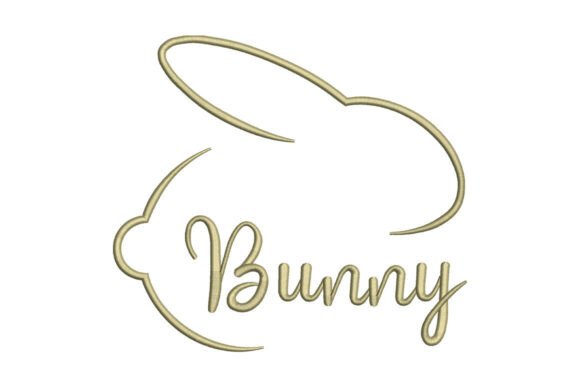
Bunny Outline Embroidery Design
A Minimalist Charm That Catches Eyes—Not Just at the Craft Fair Booth
As an embroidery designer who’s prepped over 200 craft fair booths in the past decade, I’ll tell you straight: first impressions happen in under three seconds. The Bunny Outline Embroidery Design delivers exactly that—clean, confident, and quietly memorable. It doesn’t shout “spring!” or “Easter!”; it whispers “thoughtful handmade.” That soft, flowing script paired with a single-line bunny outline reads as elegant, modern, and gently nostalgic—not cutesy, not rustic, not overly thematic. It sits comfortably in the Farm Animals category without leaning into cartoonishness, making it a rare crossover piece: equally at home on a linen tea towel in a boutique and a structured canvas tote at a farmers’ market.
Where This Design Shines—And Where It Needs Support
On tote bag design, the Bunny Outline Embroidery Design works best centered near the bottom hem or subtly angled along the side seam—its continuous stitching flows with the drape of fabric rather than fighting it. For apron embroidery, place it just above the pocket: small enough to feel intentional, large enough to read from six feet away. On tea towel embroidery, it thrives on lightweight cotton or linen-look blends—avoid heavily textured terry or waffle weaves unless you’re using extra stabilizer and reducing stitch density manually.
Embroidered patch potential? High—but only if digitized with clean jump stitches and minimal underlay. As a small shop product, this design scales beautifully for iron-on patches (3"–4" wide), especially when backed with lightweight fusible webbing. On caps, proceed with caution: the script lettering loses legibility on curved surfaces below 3.5", and the outline bunny may distort unless hooped precisely with tear-away + cutaway combo stabilizer.
For pillow covers and fabric pouches, this design feels premium—especially when stitched in tonal thread (e.g., heather gray thread on oatmeal linen). It also photographs exceptionally well for Etsy seller listings: soft shadows, natural light, and a neutral background let the smooth line work breathe. No need for busy props—the Bunny Outline Embroidery Design earns attention through restraint.
Production Realities Every Handmade Seller Should Know
This is not a “load-and-go” machine embroidery design. Its elegance depends on execution. Here’s what I check before cutting a single thread:
- Test the design on scrap fabric—same weight and weave as your final product. That “smooth, continuous stitching” can snag on loosely woven canvas or pucker on slippery satin.
- Check thread contrast deliberately. Light script on light fabric disappears in booth lighting. Go one shade darker—or use matte cotton thread instead of glossy polyester for softer definition.
- Review spacing between bunny and text. If letters crowd the outline, it reads as cluttered—not minimal. Adjust kerning in your embroidery software if your file allows editing.
- Confirm hoop size and stabilizer. A 4"x4" hoop fits most versions, but if your file includes extended flourishes, verify before batching. Use medium-weight cutaway for stable fabrics (totes, pouches); lightweight tear-away + topping for tea towels.
- Inspect stitch density. Continuous outlines often run low-density—but if the script uses satin columns or dense fill, reduce density by 10–15% on textured surfaces to avoid stiffness.
What Customers Actually Notice—and Buy
At a craft fair, shoppers don’t pause for technical specs—they pause for feeling. The Bunny Outline Embroidery Design signals quiet confidence: no glitter, no neon, no overcrowded motifs. That translates directly to perceived value. Buyers associate it with slow-made, considered goods—not mass-produced craft kits. When placed on a hand-stitched pillow cover or a heavyweight market bag, it elevates the entire handmade product.
It also strengthens brand consistency. If your shop leans into minimalist farmhouse, gentle botanicals, or Scandinavian-inspired textiles, this design reinforces your voice—no rebranding needed. And unlike seasonal motifs, it’s evergreen: works for spring markets, holiday gift fairs, baby showers, and bridal registries alike.
Careful-Use Notes You Can’t Skip
This design walks a fine line between delicate and durable. Avoid using it:
- Below 2.25" wide on dark fabric—script details vanish without high-contrast thread.
- On thick, napped fabrics (like heavy denim or sherpa) without aggressive stabilizing—it’ll sink and blur.
- As a commercial embroidery add-on for bulk orders unless you’ve stress-tested stitch count and thread breaks. Smooth lines can hide tension issues until you’re on unit #47.
- In printable mockup templates without verifying scale—many free mockups compress fine script. Always overlay your actual digital embroidery file on the mockup layer.
Final Designer Advice Before Your Next Batch
Create at least one real mockup before ordering 50 tea towels. Stitch it on your exact fabric, photograph it in the same lighting you’ll use for Etsy, and hold it at arm’s length—does the bunny still read as a bunny? Does the script flow or stutter?
Compare fabric colors side-by-side: oat, charcoal, sage, and cream all change how the Bunny Outline Embroidery Design lands. What reads as soft on ivory screams stark on black. And always—always—confirm commercial licensing terms before selling finished products. Not all embroidery file sellers grant rights for resale of physical goods.
This isn’t just another farm animals motif. It’s a versatile, mood-forward machine embroidery design built for makers who value clarity over clutter—and customers who pay more for pieces that feel intentionally made. In a sea of busy booths, the Bunny Outline Embroidery Design doesn’t compete for noise. It wins with quiet presence. And that? That sells.